Studio Di Palma
Philosophy
Heritage
Studio Di Palma was founded on a conviction, not a strategy.
The name carries a specific geography: the south of Italy, where stone walls hold the heat of the day and nothing is wasted. Where each generation inherits not wealth but knowledge. How to read material. How to work with what is available. How to make something from almost nothing.
That inheritance shapes every decision the studio makes. Not as nostalgia, but as discipline. The understanding that craft is an argument, not a decoration. That an object carries the dignity of the hand that made it. That material has memory and deserves to be chosen with care.
The vision that follows is simple: to produce work that outlasts the moment. Objects that age with meaning. Forms that could not have been made anywhere else, at any other time.
Only those who have created something from nothing have truly lived.
Materia Prima
The material is never background. It is the first sentence of every story we tell.
Every project begins with a material, not with an idea.
Wood remembers the forest it came from. Carbon fibre remembers the speeds it was designed to withstand. Recycled plastic remembers its first life, and carries that history forward. Burnished steel remembers the hand that shaped it.
We choose materials the way a writer chooses words — not for availability, but for meaning. The texture of oak against the cold precision of aluminium. The weight of brass against the lightness of woven carbon. These are not aesthetic choices. They are arguments.
At Studio Di Palma, the material is never background. It is the first sentence of every story we tell.
Tensione Creativa
The contradiction is the point.
Contrast is not a problem to be solved. It is the method.
The most enduring objects in the history of design were born from friction — between the organic and the industrial, between the ornamental and the functional, between past and future. Art Deco understood this. So did the great Italian carrozzieri. So does every watchmaker who sets a mechanical movement inside a case designed by hand.
We do not seek harmony for its own sake. We seek the productive tension between things that should not, by all logic, belong together — and then we make them inseparable.
Wood and carbon fibre. Classical proportion and radical material. Italian gesture and German precision. The contradiction is the point.
Oggetti con Anima
Not sentiment. Not nostalgia. A quality of presence that makes an object irreplaceable.
We do not design objects to be admired. We design objects to be understood.
There is a difference. An object made to be admired asks for your attention. An object made to be understood gives you something in return — a story, a sensation, a quiet recognition that someone, somewhere, thought deeply about this thing before it reached your hands.
The best objects are never finished. They age. They accumulate meaning. They become more themselves over time — like a leather notebook that carries the impression of every word written in it, or a wooden table that holds the memory of every meal.
This is what we mean by soul. Not sentiment. Not nostalgia. A quality of presence that makes an object irreplaceable — not because it cannot be copied, but because it does not need to be.
In Studio
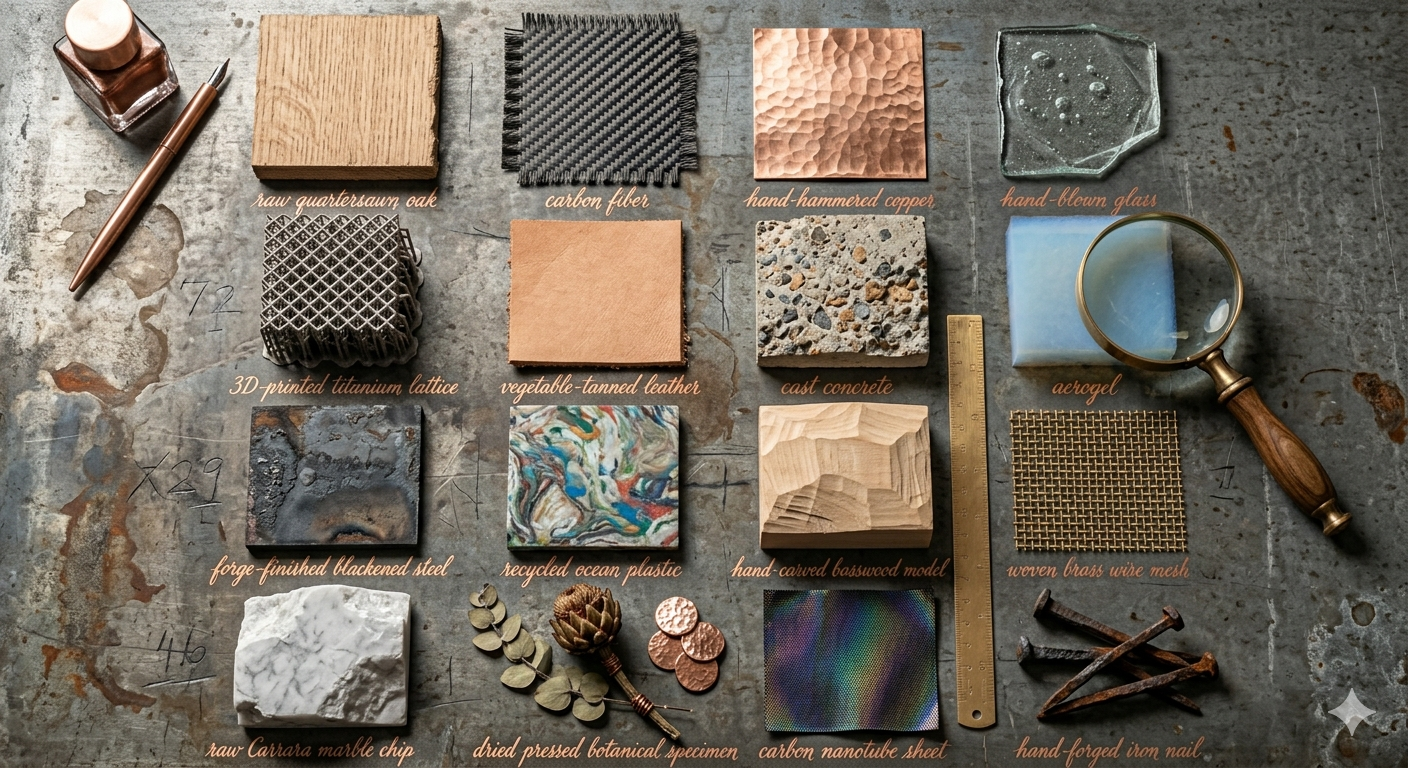
A selection of the materials used across Studio Di Palma projects — leather, bronze, hardwood, carbon fibre and natural textiles.